🗺 sfscon26
I attended SFSCON for the first time in 2024 and it was really great and I scribbled some notes about it at the time. So I decided to come back this year. Going south from Sweden in November is always rewarding. This time I combined this job trip with a short vacation in Alba - that was nice so my route by train from there was over Torino, Milano and Verona. I arrived in good time the afternoon on the day before the conferece. I had time to go for a run along the river and then I revisited Forsterbräu for some good food and their Forst beer. They have a nice dubbelbock called Sixtus.
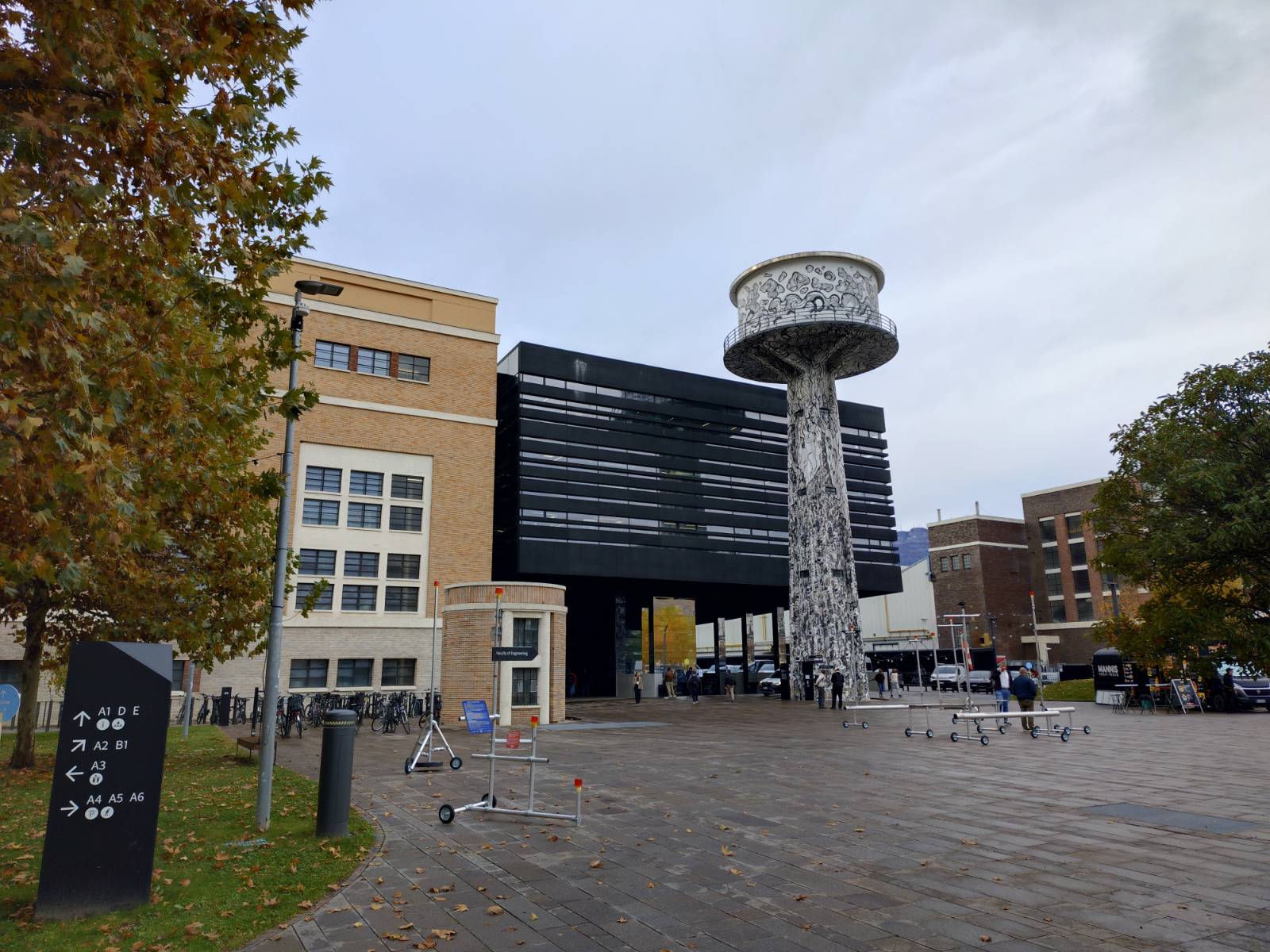
The venue was again NOI Techpark. A nice setting for a tech conference. This time I went on a tour of the premises and it was really interesting to hear about the setup and see a bit more of the place. Some 2000+ works for different companies on the site. The organization keeping it all together is a nonprofit out of the Autonomous region Bolzano.
The first part of the first day is naturally introductions and then some price awards. A bit sleepy. I really liked the opening by NOI Techpark CEO Ulrich Stofner though. The theme for this year is Digital Sovereignty - a reasonable topic when we see a weakened USA and a rising China. Shouldn’t Europe be able to provide for itself? The first keynote by Walter van Holst digged into this topic and gave an overview of things happening on the european level when it comes to acts and regulations.
Then one of the price winners - Harald Welte - had a nice talk about Free Software for building cellular networks. This area feels so proprietary and it was refreshing to hear what can be done over the different Gs. I also learned about 0G - didn’t knew that it had a name. Before the mobile networks became cellular.
These networks consisted of a single high-power radio tower geographically covering a city or wider open region, with the tower itself connected to the global telephone network
From wikipedia.
After these common tracks I opted for the Engineering room where there were 3 consecutive talks by folks from Gruppo FOS.
- Giovanni Giannotta about how to use local AI to identify insects.
- Ornede Lecini introduced us to the PoLaRecCE project that build a platform to add and view contamination data for different areas. Open Tools for Environmental Monitoring
- Finally Gianluca Lorusso about GEOWIDGET - a platform to collect data about drone activity especially tailored for emergency missions..
Next up Filip Agatić from the European Digital SME Alliance about the Tech Soverignty Catalogue. This is what it says - a catalogue of software that is built in Europe. Some of it open source and some proprietary. You can browse the catalogue here. I feel I have seen a few of these before but this one it being built by an organization for small and medium companies so it may be more thorough and long lived. A great initiative.
Then a case study of a bit of open hardware. A speaker that was marketed as open. Nicole Faerber went trough some criteria about whether it actually was open and it turned out pretty well actually.
Samantha Cruz asked Who Owns Your AI Data Pipeline? and went on to describe tactics to keep control of the data.
Then a bit of break from sitting down with the tour of the premises.
A nice email talk by Florian Effenberger about the benefits and perils of running your own mail server. If the big ones weren’t that picky it would be much easier.
GNU Taler - an interesting project to enable digital cash where the payer is anonymous but not the payee. This would make it equivalent to hard cash where the source is unkown but the receiver typically needs to declare income with authorities. Christian Grothoff made a good effort to walk us through how it works and so on. As always with these things it requires a critical mass to really take on. In Sweden we have a thing called Swish that is basically the same thing but it was created by the banks rather than an effort from below. It would be amazing with a cash like global system that everyone used.
Grigory Vodyanoy from NextCloud discussed the problems with humongous LLM-generated pull requests. The so called AIs has made it possible for non techies to some in with suggestions to open source projects. This leads to lots of work on the maintainer end. A trend one can see in many places is that developers that still care about the code is mainly doing pull request reviews rather than writing code.
And who owns the vibe code? A really interesting talk titled LLM-Generated code and Copyright by Gabriel Ku Wei Bin. According to some reasoning it may be so that if no human was involved in the creation of the actual code it should go directly to the public domain. The famous monkey selfie is a court case that supports this idea. Is it really possible to put a license on LLM-generated open source code? Naturally there are no answers to this as of yet. Legal matters always takes some time. Personally I will lean towards writing code with my own body going forward anyways. It is much more rewarding.
There were more talks but I will not write about everything to spare the reader. I went back to the city for a good nights sleep at the wonderful La Briosa. Highly recommended.
On the second day there were a full track called Digital independence day. I started there listening to the opening talk laying out the landscape for us. Numbers like:
- 90% of cloud services used in the EU are from the US
- 63% of cloud services used in the EU are from the big three US companies
- 70% och chips are made by a single company in Taiwan
- 80% of digital services in EU is bought from outside the EU
A sad story but well presented by Nino Gualdoni.
Then I hurried back to the main building to hear how Simon Dalvai the 99Managers developer had been doing. Great when it comes to getting things out and improving on the game. Not so great when it comes to making money from it.
Notburga Siller described how south tyrolean small cultural institutions build a “network of collections” in a sovereign way. A passionate talk and interesting to an culture buff like myself.
Then finally a more techie talk. Emanuele De Cupis had built wok - a command line thing used to maintain order among a myriad of repositories, branches and such. Refreshing with something closer to actual work. Not sure I need this but I will keep it in the back of my head when I navigate the repos I work with at the moment.
And the obligatory fediverse talk. I really like the fediverse so it is all good! The Free Software Foundation Europe represented and described how they use mainly mastodon for their communications. They are on commercial platforms as well but naturally prefer this more open one.
The price winner from yesterday - Harald Welte - popped up again and had the most technical talk of the conference about TTCN-3 - a domain specific language used for testing network things. Super interesting. Some thoughts from that:
- this has been around for a long time yet I did not know about it. We build many things that we then forget as an industry or a community.
- I guess it is a long time since we thought that specific languages for specific problems could be a good idea. We use our general purpose language for everything in the name of future developers not having to learn yet another language.
- I recently saw some Groovy code test some Java code.
- ok maybe this will become another post at some point.
Kudos to Harald for bringing some actual code to a presentation. I really needed it.
Michele Bottari and Davide Marchi of 3x1t.org on the digtal independence track told us that technology is not the problem when trying to solve digital sovereignty. They have set up a full stack equivalent with what you get with big tech and given it away to users. They use it for a while and then go back to their old ways. Yet again a problem of critical mass. This was illustrated with an image of a herd of cows where 85% conveniently sticked together and were just happy with current affairs. The 15 remaining % is not enough to make a difference.
THen we had Peter Aichner that had used AI to build a system to collect and index I guess different data sources and point to the real source instead of the generic mumbling of an LLM. A great idea but it was ab it sad that he had used LLMs to build it. Not talking the narrow path here.
The final talk I attended was yet another talk about AI - this time about the risk of an open source AI stack. By this time my brain was already fried and I decided to call it a day and walk back to Bolzano proper.
To clear my head I went to the art museum and got a does of Rammellzee. Also interesting in its own way.
To sum sfscon26 up then. It was a nice two days yet again. I remember two years ago that it was a bit too much about AI and it has increased since then. As compared with Fosdem there are less technical talks at this conference. But then Fosdem is huge in comparison. Here the focus is more on legal and organizational issues around open source. I did not see anyone do any live coding for example. In the end I will head north towards Sweden with a smile on my lips.
written by fredrik at 2026-11-14
Related posts